

It is common sense to try and clear your head space while you’re flying. We each have our own system for access to our flight plan and charts.
Organisation in the cockpit
Even if you are using an EFB, it's a good idea to have your backup charts appropriately folded and within reach. Also, store your charts in the order in which you are going to need them.
Make you have a fully charged phone if you plan on using it en route. Also make sure you put it somewhere accessible.
A Bluetooth enabled headset and smart phone is an invaluable combination in the cockpit.
Just make sure you turn it off to avoid distraction anywhere near take-off, landing, or circuit entry. Some people recommend not having your phone on at all below 5,000 ft. You need to make your own rule depending on your own circumstances.
Use your phone to call up an AWIS where no radio frequency is available. Why not load this into your phone before you take off? It's just one more thing you don't have to go looking for in-flight.
Don't leave home without ...
Part 91 of CASR, MOS 26.64 states:
- 'an aircraft that is flying over a remote area is required to carry appropriate survival equipment for sustaining life for the area that is being overflown'.
We all have our own lists, but here are a few items we'd recommend you don't leave home without. This includes:
- fuel carnet cards and any fuel apps required, downloaded onto your device
- cables, chargers, back-up tablet if using an EFB
- 406 MHz Personal Locator Beacon (PLB), registered and recently tested
- spare hand-held GPS with fully charged batteries
- spare hand-held radio, fully charged
- for flight in remote areas, consider hiring a satellite phone
- spare headset (if possible)
- pocket survival blanket which can also act as an earth mat that can potentially double the range of your PLB
- having a spare aircraft key cut, in case you misplace your normal key
- water – dehydration is more debilitating than you might think
- your LAME's number on speed-dial
- motion sickness bags
- a head torch if you plan on flying after dark or pre-flighting before first light
- cushions for the vertically challenged (extra comfort for long flights too)
- sun cap – test drive it under your headset before you leave home
- jellybeans. OK, they're not vital, but do take your favourite healthy snack
- some cash as some remote services might not take credit/debit cards.
And on the ground, make sure you don't forget:
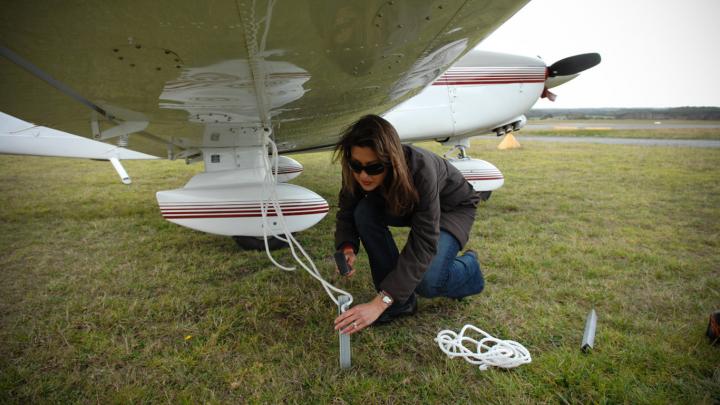
- a decent tie-down kit will let you sleep way better at night when that desert wind starts howling. A good combination is a set of three-star pickets cut to 400 mm lengths, strong ropes like braided nylon or Dacron, and a 1 kg mallet. Then as long as your knots hold, you should find your pride and joy the next morning exactly where you left it last night
- a light broom or brush to sweep away any stones in the dirt around your prop. Pick up and throw away any big ones by hand. This is a fun game for the passengers. Just make sure the master switch is off and the keys are visible, away from the ignition
- to be kind to your aircraft. If you don't have an all-over cover, pack a big sun visor to lay above her instrument panel. This is handy when she's going to be basking in the hot sun for a couple of days.
Whilst we're filling the boot, throw in your:
- tool kit
- fuel drain
- oil funnel (and plenty of spare oil)
- wheel chocks
- gust lock air filter covers.
Bugs and other visitors
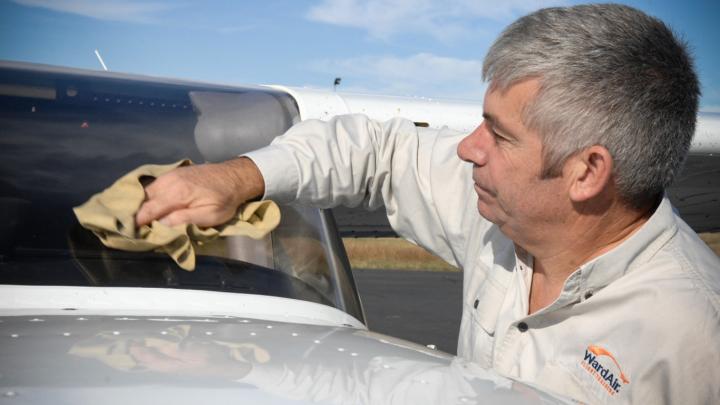
Keep your windscreen clean. As our Out-n-Back crews found out while flying from Dirranbandi to Narrabri, there's a fair chance you'll fly through farming and pastoral land. These are magnets to large swarms of flying creatures.
At certain times of year, often during harvest time, insects like grasshoppers and locusts can end up slap bang in the middle of your windscreen. You'll soon be squinting through fast-decreasing spaces between the carnage, making it very hard to see much at all.
If it's getting ridiculous, try flying at a different level. The point is, check your windscreen before each leg of your flight.
If you already have a build-up of splotches on your windscreen when you take off, then good luck spotting your destination airstrip. It would also be tough to see other aircraft traffic, particularly if you're looking into a setting sun.
Try and look after your aircraft en route rather than waiting till you get home.
Start by keeping your leading-edge surfaces as clean as possible. Bugs aren't fussy where they land.
Next time you have a weather-induced lay day somewhere, why not give the plane a wipe down? As you and your wet cloth make your way around the aircraft, take the opportunity of checking all's well with:
- rivets
- hinges
- other nooks and crannies of the airframe you might have not inspected for a while.
On your daily inspection, check that a bug hasn't crawled into your pitot tube where it's safe and warm.
This is a good place to remind you (before you leave home) to make sure your pitot tube cover fits snugly. There should be no inviting gaps or worn elastic.
Related resources
- Bathurst: The journey begins
- Birdsville, Boulia and Mount Isa
- Mount Isa to Karumba
- Kowanyama, Laura and Cooktown
- Port Douglas, Cairns, and Mareeba
- Townsville, Shute Harbour and Hamilton Island
- Rockhampton
- Old Station
- Emerald and Longreach
-
Lake Keepit, Rylstone and flying home
Pages in this section
-
Episode 28: Electronic flight bags
Learn the essentials of traveling with electronic flight bags (EFBs), the importance of scanning, and being aware of your surroundings.
-
Episode 29: Interview with Ian Downes at Lake Keepit gliding club
An interview with Ian Downes at Lake Keepit gliding club. The crew learn about the nuances of soaring and gliding and experience firsthand a what it’s like to fly in one.
-
Episode 30: Interview with Rob Loneragan at Rylstone airpark
In their final interview for the series, the Out-n-Back crew chat with Rob Loneragan, owner of Rylstone airpark and how the park supports the aviation industry.
-
Episode 31: Housekeeping tips
Some key tips and tricks around organising your cockpit to suit you, what you shouldn’t leave home without, and keeping your windshield clean.
-
Aerodromes: Charleville, Narrabri, Lake Keepit, Tamworth and Rylstone
A list of information for pilots travelling to some of NSW’s and Queensland’s remote and regional aerodromes.
-
Episode 28: Electronic flight bags
-
Aircraft
-
Aircraft registration
- Change, transfer or cancel aircraft registration
- Data files for registered aircraft
- Ferry flight registrations
- Find a registered aircraft
- Guidance for deceased estates
- Irrevocable deregistration and export request authorisation (IDERA)
- Register your aircraft
- Registered aircraft operators
- Registration marks
- Request a copy of your registration certificate
-
Airworthiness
- Airworthiness Bulletins
- Airworthiness Directives
- Continuing airworthiness
- Continuing Airworthiness Management Organisations
- Foreign airworthiness data
- Report defects
- Maintenance organisations
- Maintenance training organisations
- Find a Part 147 maintenance training organisations
- Mounting small cameras in aircraft
- Certification
- Design and manufacturing
- Sport aviation
-
Aircraft registration
-
Drones
- Drone rules
- Operator accreditation certificate
- Remote pilot licence
- Remotely piloted aircraft operator's certificate
- Drone registration
-
Flight authorisations
- About our assessment framework
- Advanced operations
- Beyond visual line-of-sight operations
- Extended visual line-of-sight operations
- Flight approvals and permissions
- Flying at night
- Flying multiple drones at once
- Flying over and near people
- Model aircraft flight authorisation
- Remotely piloted aircraft systems compliance
- Flight authorisation trials
- Industry initiatives
-
Licences and certificates
- Pilots
- Radio operators
- Air traffic controllers
-
Air operators
- Aerial application air operator's certificate
- Aerial work certificate (Part 138)
- Air transport air operator's certificate
- Alternative pathways for specialised endorsements
- Balloon air operator's certificate
- Flight training operators
- Foreign operators
- Guidance for Part 91 approvals
- Replace air operator's certificate
- Aerial photography from aircraft
- Part 133 rotorcraft performance
- Delegates
-
Maintenance engineers
- About aircraft maintenance engineers
- Aircraft maintenance engineer exams
- Aircraft maintenance engineer licence (Part 66)
- Apply for a Part 66 licence
- Become a licensed aircraft maintenance engineer
- Maintenance of composite structures
- Part 66 and working for a Part 145 organisation
- Part 66 self-study training and examination pathway
- Recognition of prior learning
- Removing exclusions
- Licence currency and requalification
- Modular licensing for aircraft maintenance engineers
- Part 66 modular aircraft maintenance engineer licence pathways
- Flight examiners
- Flight instructors
- Aviation medicals
- Medical professionals
- Aviation reference numbers
- English language standards
-
Operations, safety & travel
- Aerodromes
- Airspace
- Aviation safety for pilots
- Safety Management Systems
-
Safety advice
- Cabin safety
- Carriage or discharge of firearms on aircraft
- Community service flights
- Cost sharing flights
- Dangerous goods and air freight
- Displays and events
- Drug and alcohol management
- Electronic flight bag
- Fatigue management
- Hazard identification and management
- Human factors and safety behaviours
- Mercy fights and operating in an emergency
- 5G and aviation safety
- 5G and radar altimeters
- Ways to submit a safety report
- Consumer and passenger advice
- Aeronautical information management
- Training and checking systems
-
Rules
- Regulatory framework
- Rules by category
- Rules by status
- Rules by type
- Changing the rules
-
Compliance and enforcement
- Delegated authority in support of aviation safety investigations
- Enforcement action
- How to comply with the rules
- Recent enforcement actions
- Safety information policy statement
- Sharing safety information
- Strict liability
- Surveillance
- Voluntary suspensions
- Recent enforcement actions
- Reporting unsafe behaviour
- Resources & education
-
About us
- Who we are
- Who we work with
- News, media releases and speeches
-
Reporting and accountability
- Artificial intelligence transparency statement
- Environmental management and performance
- Freedom of information
- Gift and benefits register
- Gender pay gap employer statement
- List of CASA files
- Portfolio budget statements
- Register of privacy impact assessments
- Regulator Performance Framework
- Senate order on agency contracts
- Service standards
- Statement of commitment to child safety
- Work health and safety policy statement
- Protecting the environment
- External security vulnerability disclosure program
- Careers
- Sponsorship and scholarship
- About this website
- Contact us
- Events
- Subscribe