

Setting up your safety management system (SMS) isn't hard. In fact, you probably already have a lot of the work done.
To understand what's involved in setting up an SMS, follow these steps:
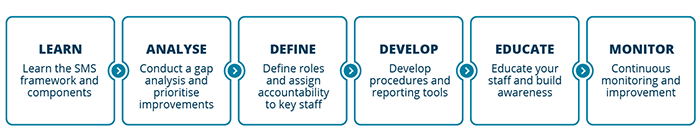
Setting up your safety management system (SMS) isn't hard. In fact, you probably already have a lot of the work done.
To understand what's involved in setting up an SMS, follow these steps:
There are 4 main components to include in your SMS. These will provide the structure for creating a scalable SMS.
Policy is the foundation of your SMS.
It must include:
Tip: Make sure your staff can find and understand your safety policy.
To learn more:
This is the core safety work.
Your safety risk management process must include:
Ask yourself:
To learn more:
Safety assurance checks whether your SMS is working.
Activities include:
To learn more:
Safety is not static. It depends on people.
Safety promotion includes:
Tip: Reinforce safety messages in many formats, such as in briefings, bulletins, safety meetings and posters.
To learn more:
A gap analysis shows where your current processes meet SMS requirements, and where they do not.
Use our helpful SMS gap analysis and implementation tool to:
With your gap analysis results, you can create an implementation plan to fill any SMS shortfalls.
Safety belongs to everyone. But some roles have special responsibilities.
Typical safety roles include:
The chief executive officer and the safety manager both play a central role in your organisation's SMS. Together, they ensure the SMS is effectively managed and operating as intended.
Refer to our Safety Manager Guide for more information.
Map out your SMS in an SMS manual to address the four SMS framework components. This will help you apply it in a consistent way. Your SMS documentation also includes:
For air transport or aerial work operators who relied on exemptions that delayed the introduction of your SMS, you must have an SMS in place by 2 December 2026.
We have developed 2 sample SMS manual versions to assist you implement and operate an SMS that is suitable for your operations. Each version of the manual addresses the SMS framework requirements and includes the following documents and templates:
Ensure your organisation's SMS documentation is accessible, explains the SMS clearly and integrates it into daily operations.
A safety reporting system records hazards, risks and incidents. This provides data to help you stop them happening again. The reporting system must:
provide timely feedback to staff when they report.
Safety doesn't happen on its own. It's shaped by people's actions. The right training will help your staff build safety into every day.
Create a training plan that covers:
Schedule time to teach SMS topics, including safety briefings, meetings, workshops and during induction training.
Your internal safety culture is not static. Regular review helps you improve your SMS and embed documented safety practices in your workplace. Be sure to update you SMS manual as your safety practices evolve.
To strengthen your safety culture over time, you can: