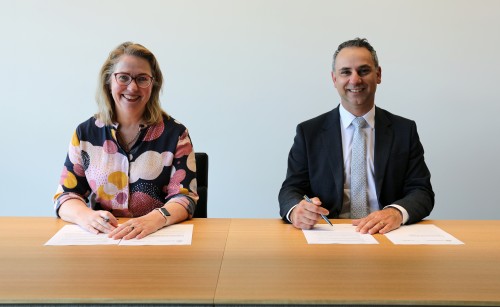
This week marked a significant milestone for Australian aviation and the Australian space sector, with CASA and the Australian Space Agency signing a Memorandum of Understanding (MoU).
The agreement formalises cooperation between the two agencies to support efforts to enhance the safety of spaceflight and air navigation.
It establishes a framework for stronger regulatory cooperation and improved information sharing, and will build confidence for the benefit of Australia’s space and aviation industries.
Covering everything from planned launches and returns, managing unplanned space debris re-entries and international cooperation, the agreement builds on a shared commitment to continue positioning Australia as a responsible and globally regarded space and aviation nation.
Pip Spence, CASA Chief Executive Officer and Director of Aviation Safety, said the MoU is a significant step toward ensuring a coordinated national approach to aviation safety.
'Lessons learned from recent rocket launches have helped shaped our approach and clarified roles and responsibilities between our two agencies,' Ms Spence said.
'The MoU positions us well to further support innovation and ensure a seamless experience for space and airspace users, while maintaining aviation safety as our shared primary focus.
'We look forward to continuing to work closely with the Australian Space Agency in supporting Australia's rocket and space industry.'
Enrico Palermo, Head of the Australian Space Agency, said that as Australia’s space sector grows, ensuring a coordinated approach between space operations and air operations is critical.
'This agreement strengthens our partnership with CASA and reflects our commitment to work together to protect both spaceflight and aviation safety,' Mr Palermo said.
'We're showing the world that Australia is a suitable place to do space, and that is strengthened by our whole-of-government approach.'
The MoU includes four areas of collaboration and prioritisation between CASA and the Australian Space Agency:
- Regulatory cooperation
- Space-related airspace risk management
- Collaboration on emerging and complex aviation and spaceflight technologies
- Joint engagement on multilateral international issues.
View the Memorandum of Understanding.
-
Aircraft
-
Aircraft registration
- Change, transfer or cancel aircraft registration
- Data files for registered aircraft
- Ferry flight registrations
- Find a registered aircraft
- Guidance for deceased estates
- Irrevocable deregistration and export request authorisation (IDERA)
- Register your aircraft
- Registered aircraft operators
- Registration marks
- Request a copy of your registration certificate
- Airworthiness
- Certification
- Design and manufacturing
- Sport aviation
-
Aircraft registration
- Drones
-
Licences and certificates
- Pilots
- Radio operators
- Air traffic controllers
-
Air operators
- Aerial application air operator's certificate
- Aerial work certificate (Part 138)
- Air transport air operator's certificate
- Alternative pathways for specialised endorsements
- Balloon air operator's certificate
- Flight training operators
- Foreign operators
- Guidance for Part 91 approvals
- Replace air operator's certificate
- Aerial photography from aircraft
- Delegates
-
Maintenance engineers
- About aircraft maintenance engineers
- Aircraft maintenance engineer exams
- Aircraft maintenance engineer licence (Part 66)
- Apply for a Part 66 licence
- Become a licensed aircraft maintenance engineer
- Maintenance of composite structures
- Part 66 and working for a Part 145 organisation
- Part 66 self-study training and examination pathway
- Recognition of prior learning
- Removing exclusions
- Licence currency and requalification
- Modular licensing for aircraft maintenance engineers
- Part 66 modular aircraft maintenance engineer licence pathways
- Flight examiners
- Flight instructors
- Aviation medicals
- Medical professionals
- Aviation reference numbers
- English language standards
-
Operations, safety & travel
- Aerodromes
- Airspace
- Aviation safety for pilots
- Safety Management Systems
-
Safety advice
- Cabin safety
- Carriage or discharge of firearms on aircraft
- Community service flights
- Cost sharing flights
- Dangerous goods and air freight
- Displays and events
- Drug and alcohol management
- Electronic flight bag
- Fatigue management
- Hazard identification and management
- Human factors and safety behaviours
- Mercy fights and operating in an emergency
- 5G and aviation safety
- Consumer and passenger advice
- Aeronautical information management
- Rotorcraft performance standards for flight operators
- Training and checking systems
-
Rules
- Regulatory framework
- Rules by category
- Rules by status
- Rules by type
- Changing the rules
-
Compliance and enforcement
- Delegated authority in support of aviation safety investigations
- Enforcement action
- How to comply with the rules
- Recent enforcement actions
- Safety information policy statement
- Sharing safety information
- Strict liability
- Surveillance
- Voluntary suspensions
- Recent enforcement actions
- Reporting unsafe behaviour
- Resources & education
-
About us
- Who we are
- Who we work with
- News, media releases and speeches
-
Reporting and accountability
- Environmental management and performance
- Freedom of information
- Gift and benefits register
- Gender pay gap employer statement
- List of CASA files
- Portfolio budget statements
- Register of privacy impact assessments
- Regulator Performance Framework
- Senate order on agency contracts
- Service standards
- Statement of commitment to child safety
- Work health and safety policy statement
- Protecting the environment
- External security vulnerability disclosure program
- Careers
- Sponsorship and scholarship
- About this website
- Contact us
- Events
- Subscribe